
How does IVF work? Although the IVF process is tailored for each patient, here is your general, step-by-step guide to a IVF cycle at Manchester Fertility:
Step 1: Pre-treatment tests
Your IVF journey will begin with a detailed fertility assessment. This helps our specialists understand your unique circumstances and design a personalised treatment plan that gives you the best possible chance of success.
Pre-treatment tests include:
- Ultrasound scans – to check your uterus and ovaries.
- Ovarian reserve testing – to assess your egg quantity and quality.
- Hormone tests – to understand your reproductive hormone levels.
- Semen analysis – if using partner sperm, to evaluate sperm health and function.
We’ll also carry out a general health and lifestyle review. This ensures there are no underlying factors that could affect your treatment outcome.
If you have had treatment elsewhere, you can request a full copy of your records from your previous clinic. If your results are still current, we will arrange a consultation with one of our specialists. If any investigations have expired, they will be repeated before your consultation.
Step 2: Consultation with a fertility doctor
The next step is to have a consultation with one of our fertility doctors, they will explain all the results of your tests and talk through your full medical history.
Your doctor will use these results to personalise your IVF cycle, and will explain the specific plan that is best for you and why. They are here to listen, support and reassure you, so don’t be afraid to ask questions if you are unsure about anything.
At the end of your consultation, you will understand what your IVF cycle entails with a full breakdown of how much it costs, with available funding options.

Step 3: The start of IVF - Ovarian stimulation
Your IVF cycle starts with ovarian stimulation, which begins on day 1 of your period.
Our fertility nurses will show you how to self-inject your fertility medications, which are hormones naturally produced by the body for egg growth and ovulation.
The type of fertility drugs you take, the dosage and timing will be unique to you, focused on achieving a good number of quality eggs for your IVF cycle. You will be carefully monitored during this phase, with regular scans at our clinic to check your ovarian response.
Step 4: Egg maturation
When your scan shows that your eggs are at the right growth stage, you will administer what is known as the ‘trigger’ injection. This is a hormone that helps your eggs to go through the final growth stage and releases the eggs from the follicles, so we can perform egg collection.
This part is a key stage in what happens during IVF, as it prepares your eggs for retrieval and fertilisation.
Step 5: Egg collection
Around 35-38 hours after the ‘trigger’ injection, egg collection takes place in our clinic theatre, under light sedation for your comfort. Your fertility doctor will retrieve your eggs under ultrasound guidance and tell you how many eggs you have for your IVF cycle. You will be looked after by our theatre team including anaesthetists and fertility nurses.
If you are using partner sperm, he will give a sample on the same day as your egg collection, so his sperm is ready to inseminate your eggs in our lab.
Step 6: Insemination of eggs
Your eggs are immediately taken to our IVF laboratory where they will be added to a prepared washed sample of your partner’s sperm or donor sperm.
Or, your eggs can be inseminated via ICSI, a refinement of IVF, where a single healthy sperm is injected directly into each egg. This will be decided in your treatment plan.
Step 7: Fertilisation
Fertilisation usually occurs around 16-18 hours after insemination. Our lab team will monitor your eggs and call you to advise if any of your eggs have fertilised and how many embryos you have.
Step 8: Embryo development
Your embryos are placed in an incubator where they will grow for the next two to five days, in optimum conditions for embryo development.
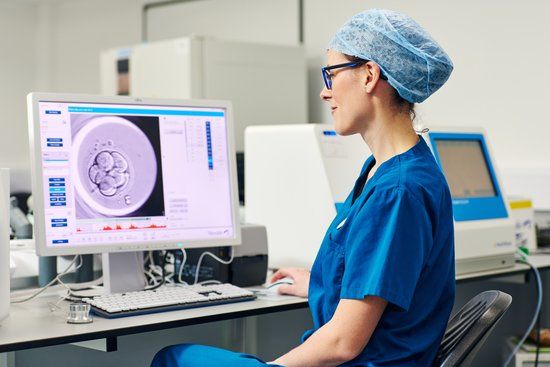
Embryos are developed in our Embryoscopes, which are special incubators that create a time-lapse video of embryo growth. Our embryologists will keep you updated on the progress of your embryos and advise when your embryo transfer will take place.
Step 9: Embryo transfer & storage
Embryo transfer is the final stage of your IVF cycle. Our expert embryologists select the embryo with the highest pregnancy potential for your embryo transfer.
The embryo chosen is transferred under ultrasound guidance into your uterus. Any remaining good quality embryos will be frozen using advanced methods, for future treatment cycles.
Step 10: Pregnancy test & scan or follow-up
Around two weeks after your embryo transfer, you can take an at-home pregnancy test. During this time, you will be supported by our clinic midwife.
If your test is positive, you will be booked in for your early pregnancy scan about three weeks later. If your test is negative, you will see your fertility consultant for a follow-up to discuss next steps and be given full counselling and support from our team.
Ready to start IVF?
Book your free 1-2-1 discovery appointment with one of our friendly New Patient Coordinators and take the first step toward growing your family.
If you have any questions about the IVF process, our team is happy to help on 0161 300 2730.
Last updated: 23rd October 2025