woman looking at mobile phone

Low AMH: Understanding Your Ovarian Reserve

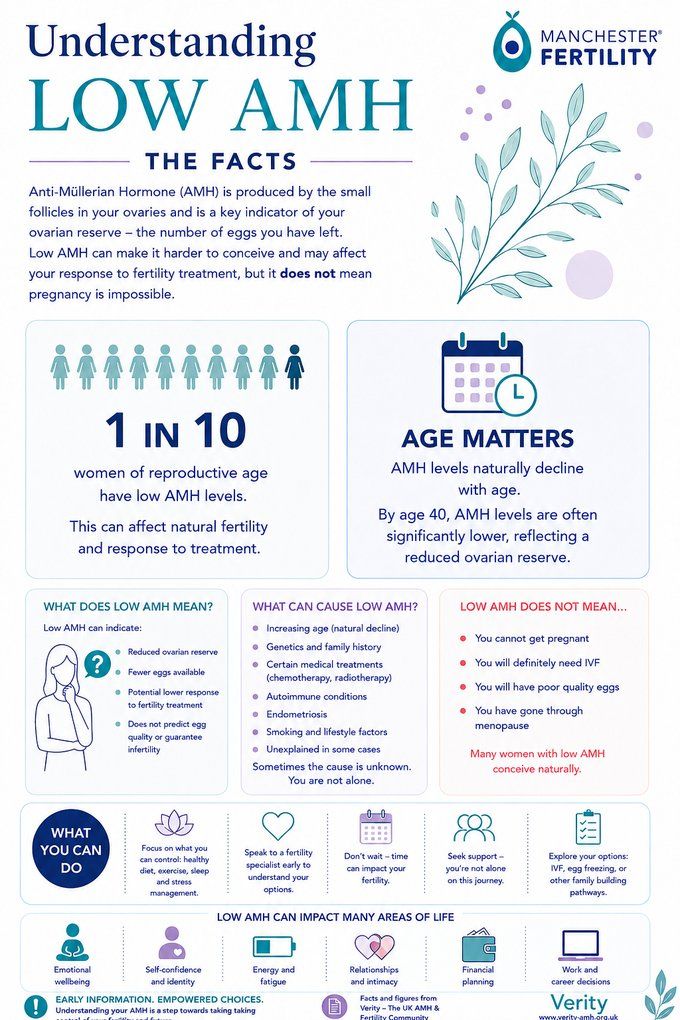
A low AMH result can feel concerning, but it does not mean that pregnancy is impossible.

What is low AMH?

AMH, or Anti-Müllerian Hormone, is produced by small follicles in the ovaries. An AMH blood test can help give an indication of your ovarian reserve, which refers to the number of eggs remaining in your ovaries.

A lower AMH level can indicate a lower ovarian reserve. However, an AMH result does not tell us the quality of your eggs, whether you can become pregnant naturally or exactly when you will reach menopause.

Your AMH result should always be considered alongside other important factors, including your age, medical history, menstrual cycle and an ultrasound assessment of your ovaries.

At Manchester Fertility, we look at the whole picture before recommending your next steps.

Low Ovarian Reserve fact shet

What Does a Low AMH Result Mean For My Fertility?

Receiving a low AMH result can feel worrying, but it is important to understand what the result can and cannot tell you.

Low AMH generally suggests that you may have fewer eggs available than expected for your age. If you undergo IVF, it may also indicate that your ovaries could produce fewer eggs in response to fertility medication.

But low AMH does not mean there are no eggs remaining, and it does not mean pregnancy is impossible.

Your age is particularly important because egg quality generally declines as we get older. Two people with the same AMH result may therefore have very different fertility prospects and may be recommended different treatment approaches.

What Can Cause Low AMH?

Low AMH usually indicates a lower ovarian reserve, meaning there may be fewer eggs remaining in the ovaries. AMH levels naturally vary from person to person, and a low result does not always mean there is an underlying medical problem.

1

Age

Age is the most common reason for a lower AMH level. Ovarian reserve naturally declines over time, with the decline generally becoming more significant during the mid-to-late 30s and into the 40s. However, some younger women may also have a lower-than-expected AMH level for their age.

2

Individual ovarian reserve

Everyone is born with a different number of eggs. Some people naturally have a lower ovarian reserve than others, even when they are young, healthy and have regular menstrual cycles. In some cases, there may be no identifiable reason for a low AMH result.

3

Previous ovarian surgery

Surgery involving the ovaries can sometimes reduce ovarian reserve, particularly when ovarian tissue is removed or affected. This may include surgery to treat ovarian cysts or endometriomas.

4

Endometriosis

Endometriosis, particularly when it affects the ovaries and causes endometriomas, may be associated with a lower ovarian reserve. Both the condition itself and, in some circumstances, surgery to treat ovarian endometriomas can affect AMH levels.

5

Chemotherapy and radiotherapy

Some cancer treatments can damage the follicles within the ovaries and reduce ovarian reserve. The effect varies depending on factors such as the type and dose of treatment, the area treated and the person's age at the time of treatment.

6

Genetic and chromosomal factors

In some cases, a reduced ovarian reserve may be associated with genetic or chromosomal factors. If there is a family history of premature or early menopause, or if ovarian reserve appears unexpectedly low for your age, your specialist may recommend further investigation.

7

Premature ovarian insufficiency (POI)

Premature ovarian insufficiency occurs when the ovaries stop functioning normally before the age of 40. Low or very low AMH may be seen in people with POI, although diagnosis is not based on AMH alone and requires appropriate clinical assessment and other tests.

8

Smoking and lifestyle factors

Smoking has been associated with an earlier decline in ovarian reserve and an earlier menopause. Other lifestyle and environmental factors are still being studied, and AMH should not be interpreted as a simple measure of general health or lifestyle.

Sometimes, there is no clear cause

It is possible to have low AMH without an obvious explanation. Your AMH result should therefore be considered alongside your age, menstrual history, antral follicle count (AFC), medical history and any previous fertility treatment.

A low AMH result does not, by itself, mean that you cannot become pregnant. AMH is primarily used to estimate ovarian reserve and help predict how the ovaries may respond to stimulation during fertility treatment. It does not directly measure egg quality or provide a definitive prediction of your chances of conceiving naturally.

Book a Fertility Assessment

Our fertility assessment packages are designed for new patients who want to better understand their fertility before trying to conceive.

Learn More

Can I get Pregnant Naturally With Low AMH?

Yes. It may still be possible to become pregnant naturally if you have low AMH.

One of the biggest misconceptions about low AMH is that it means you cannot conceive without fertility treatment. In reality, AMH measures your ovarian reserve, the estimated number of eggs remaining in your ovaries, rather than your ability to become pregnant naturally.

A low AMH result does not tell us whether you are ovulating each month, whether your eggs are healthy enough to be fertilised, or whether pregnancy will occur. It is simply one piece of the fertility puzzle.

Your chance of conceiving naturally depends on several important factors, including:

  • Your age
  • Whether you are ovulating regularly
  • The quality of your eggs
  • Whether your fallopian tubes are open and healthy
  • The health of your uterus
  • Your partner's sperm count, motility and morphology (where relevant)
  • Your overall health and lifestyle

For younger women, a low AMH result may have less impact on the chances of natural conception because egg quality is generally better at a younger age. Conversely, as women get older, both the number and quality of eggs naturally decline, which can affect fertility regardless of AMH levels.

Research has shown that many women with low AMH conceive naturally, particularly if they are ovulating regularly and have no other underlying fertility issues. For this reason, AMH should never be used on its own to predict your ability to get pregnant.

If you've been trying for a baby without success, have irregular periods or have received a low AMH result, it's worth seeking advice from a fertility specialist. A comprehensive fertility assessment can provide a much clearer picture of your reproductive health than an AMH test alone.

At Manchester Fertility, we offer fertility assessments that combine your AMH result with an ultrasound scan, your medical history, your age and any additional fertility investigations to build a complete understanding of your fertility. This allows us to provide personalised advice on whether continuing to try naturally or considering fertility treatment is the most appropriate next step for you.

Our Fertility assessments are £465 for heterosexual couples and £365 for single females.

What Fertility Treatment is Available For Low AMH?

The right approach will depend on your age, test results, fertility history and family-building goals.

For some people, we may recommend continuing to try naturally for a period of time. For others, fertility treatment may be appropriate.

Treatment options can include:

IVF

Your ovaries are stimulated with fertility medication before eggs are collected and fertilised in our laboratory.

Learn More

ICSI

A single sperm is injected directly into an egg to help fertilisation where appropriate.

Learn More

IVF With Donor Eggs

Donor eggs may be considered where treatment using your own eggs is unlikely to offer a reasonable chance of success.

Learn More

What Happens If I Have Low AMH?

1

Fertility Assessment

We start by understanding your fertility and medical history.

Your test may include an AMH blood test, an ultrasound scan to assess your ovaries and an antral follicle count, together with any other investigations your specialist recommends.

Our Fertility assessments are £465 for heterosexual couples and £365 for single females.

2

Consultation

During your fertility assessment, you will meet with one of our fertility consultants to discuss your results.

Your consultant will explain what your AMH level means in the context of your age and wider fertility health, answer your questions and discuss your options.

3

Personalised treatment plan

If fertility treatment is recommended, we will create a treatment plan tailored to you.

Your consultant will discuss the recommended approach, expected response to treatment and any alternatives you may wish to consider.

4

Ovarian stimulation and monitoring

If you proceed with IVF using your own eggs, fertility medication is used to stimulate the ovaries.

Your response is carefully monitored with scans and, where required, blood tests throughout your cycle.

5

Egg collection and fertilisation

When your follicles are ready, your eggs are collected and fertilised in our laboratory using IVF or ICSI, depending on your treatment plan.

6

Embryo transfer

If a suitable embryo develops, it may be transferred to your uterus or frozen for use in a future treatment cycle, depending on your individual circumstances.

7

Ongoing support

We will support you throughout your treatment and explain each stage clearly.

If a cycle does not go as hoped, your specialist can review the outcome with you and discuss your next steps.

Why Manchester Fertility?

Our experienced fertility specialists understand the complex relationship between low AMH and fertility.

When you choose us, you'll benefit from:

  • Consultant-led fertility care
  • Personalised treatment plans
  • Advanced IVF technology
  • Over 40 years of experience
  • Dedicated nursing support
  • Transparent pricing
  • High success rates
  • A compassionate, experienced multidisciplinary team

Does Low AMH Affect IVF Success?

A low AMH level can affect how your ovaries respond to fertility medication during an IVF cycle, but it does not determine whether IVF will be successful.

AMH is commonly used by fertility specialists to estimate how many eggs may be retrieved following ovarian stimulation. Women with low AMH often produce fewer follicles in response to medication, which can result in fewer eggs being collected during egg retrieval.

However, having fewer eggs does not necessarily mean you have a lower chance of achieving a healthy pregnancy. The quality of the eggs collected is often more important than the quantity, and egg quality is largely influenced by age rather than AMH levels.

FAQs

What is considered a low AMH level?

AMH results need to be interpreted in context, particularly alongside your age and other fertility assessments. Your consultant will explain what your individual result means for you rather than relying on a single number alone.

Does low AMH mean infertility?

No. Low AMH indicates a lower ovarian reserve, but it does not mean you cannot conceive. Some people with low AMH become pregnant naturally, while others may benefit from fertility treatment.

Can AMH levels increase?

AMH levels can vary between tests, but ovarian reserve naturally reduces over time. There is no established treatment that can restore the number of eggs in the ovaries. Your fertility specialist can advise you on the options available based on your current fertility assessment.

Can I have IVF with very low AMH?

Potentially, yes. Whether IVF using your own eggs is appropriate will depend on your individual circumstances, including your age, ovarian reserve and previous treatment history. Your consultant will discuss the potential benefits, limitations and alternatives with you.

Does low AMH mean poor egg quality?

Not necessarily. AMH is mainly an indicator of egg quantity rather than egg quality. Age is one of the most important factors associated with egg quality.

Can I freeze my eggs if I have low AMH?

Egg freezing may be possible, but a lower ovarian reserve can mean fewer eggs are collected in each cycle. Your specialist can assess your circumstances and discuss whether egg freezing is an appropriate option for you.

Should I try for a baby sooner if I have low AMH?

Your AMH result should be considered alongside your age and wider fertility health. If you are concerned about your fertility or future family plans, seeking specialist advice can help you understand your options.

Can I still get pregnant with low AMH?

Yes. Low AMH does not mean you cannot get pregnant. AMH is a measure of your ovarian reserve (the number of eggs remaining), not the quality of your eggs or your ability to conceive naturally. Many women with low AMH go on to have successful pregnancies.

Ready To Take The Next Step?

Whether you have any further questions regarding low AMH or have been trying to conceive for some time, our experienced fertility team is here to help you understand your options.

Book Your Fertility Assessment Today

A fertility assessment involves a series of simple tests and a consultation with a doctor.

We will assess your current fertility status, identifying any factors affecting your ability to conceive and providing insight into potential treatment options.

Our Fertility assessments are £465 for heterosexual couples and £365 for single females.
Book Now

Want to know more about low AMH?

  • Book a free 1-2-1 call

    Speak to one of our friendly co-ordinators to find out exactly which type of fertility testing option suits you.

  • Request a callback

    Fill in your details here and we'll call you back to discuss our fertility testing options

  • View our fertility treatments

    Find out more about our fertility treatments.

Close

Call now

New patients

0161 300 2737

Lines open 8am - 6pm, Monday - Friday.

Existing patients

0161 300 2730

Lines open 7:30am - 6pm, Monday - Friday.

Weekends and Bank Holidays - lines open 8am - 12pm.

Friendly Manchester Fertility staff member

Did we answer all your fertility questions today?

If you still feel you need more guidance and support, you can book a FREE 1-2-1 discovery meeting to talk through the options available to you.