
Starting fertility treatment can feel exciting, but it can also come with plenty of questions. One of the most common is: how long will fertility treatment take?
The answer depends on several factors, including the type of treatment you’re having, your individual fertility history, the investigations you need and how your body responds to treatment.
Understanding the typical fertility treatment timeline can help you feel more prepared and know what to expect at each stage.
At Manchester Fertility, we create personalised treatment plans based on your individual circumstances, so your journey may look slightly different from someone else’s.
Step 1: Your initial fertility consultation
Your fertility journey usually begins with an initial consultation.
This is an opportunity to discuss your fertility history, any previous pregnancies or treatments, and your general health.
Your fertility specialist may also recommend investigations to identify the most appropriate treatment options.
Depending on your circumstances, these may include blood tests, an ultrasound scan or semen analysis.
Your specialist will explain which tests you need and what the results may mean for your treatment.
Step 2: Fertility investigations and treatment planning
Before starting treatment, your fertility team will review your test results and discuss your options with you.
For some people, investigations may identify a specific reason why they are having difficulty conceiving. For others, there may not be an obvious explanation.
Your treatment plan will depend on factors such as:
- Your age
- Your fertility history
- Your ovarian reserve
- Sperm health, where applicable
- Previous fertility treatment
- Any underlying medical conditions
- The type of treatment recommended
Your specialist should explain why a particular treatment is being recommended and what you can expect from the process.
Step 3: Preparing for treatment
Once you've decided to proceed, your clinic will explain how to prepare for your treatment cycle.
For IVF or ICSI, this may involve medication to stimulate the ovaries so that multiple eggs can develop.
You'll be given instructions about when to start your medication and how to administer it. Your clinic will also explain when you need to attend appointments for monitoring.
The preparation stage can vary from person to person, so it's important to follow the specific treatment schedule provided by your fertility team.
Step 4: Ovarian stimulation and monitoring
During an IVF or ICSI cycle, fertility medication is used to encourage the ovaries to develop several follicles.
You'll usually have monitoring appointments during this stage. These may involve ultrasound scans and, where appropriate, blood tests to assess how your ovaries are responding.
Your fertility team will use the results to determine when your eggs are ready for collection.
This stage is carefully monitored because everyone responds differently to fertility medication.
Step 5: Egg collection
Once your follicles are ready, you'll be given medication to help your eggs reach the appropriate stage of maturity.
Egg collection is then carried out as part of your IVF or ICSI treatment.
The procedure involves collecting eggs from the ovaries, which will then be prepared for fertilisation by the embryology team
Your fertility team will explain what happens before, during and after the procedure, including any preparation you need to complete beforehand.
Step 6: Fertilisation and embryo development
Following egg collection, the eggs are assessed by the embryology team.
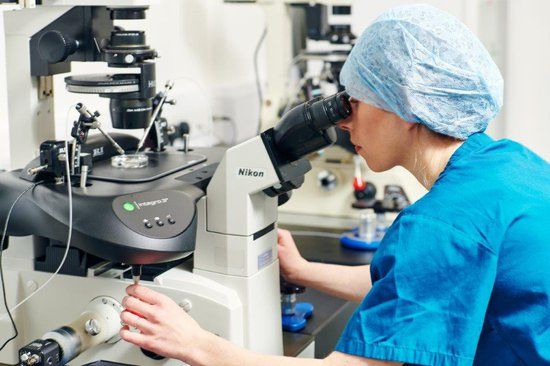
Depending on your treatment plan, fertilisation may take place through conventional IVF or using ICSI, where a single sperm is injected directly into an egg.
The resulting embryos are then monitored as they develop in the laboratory.
Your embryology team will keep you informed about embryo development and explain what happens next.
Step 7: Embryo transfer
If you are having a fresh embryo transfer, this may take place a few days after egg collection, depending on your individual treatment plan and embryo development.
During an embryo transfer, an embryo is placed into the uterus using a thin catheter.
In some circumstances, embryos may be frozen for a later frozen embryo transfer instead. Your fertility specialist will explain which approach is appropriate for you.
Step 8: Taking a pregnancy test
After embryo transfer, you'll be given a date for your pregnancy test.
This waiting period can feel like one of the most emotionally challenging parts of fertility treatment. It's completely understandable to feel hopeful, anxious or a mixture of emotions.
Your clinic will advise you when to take the test and what to do depending on the result.
It's important to follow your medication instructions during this time and contact your fertility team if you have any concerns.
How long does fertility treatment take?
There isn't one standard timeline for everyone.
An IVF or ICSI cycle itself can take several weeks, but the overall process may be longer if you need additional investigations, treatment preparation or a frozen embryo transfer.
Your timeline may also change depending on how you respond to medication and whether your fertility specialist recommends adjusting your treatment.
For this reason, it's best to think of fertility treatment as a personalised process rather than a fixed number of days or weeks.
What if my treatment cycle doesn't go to plan?
Fertility treatment doesn't always follow the expected timeline.
Sometimes a cycle may need to be adjusted or postponed for medical reasons. In other circumstances, there may be fewer eggs or embryos than expected, or an embryo transfer may not be recommended at that stage.
If this happens, your fertility team will explain why and discuss your options with you.
While this can be disappointing, it doesn't necessarily mean that treatment won't be successful in the future. Your specialist can review what happened and consider whether changes to your treatment plan may be appropriate.
The importance of personalised care
One of the most important things to remember is that there is no single fertility treatment timeline.
Two people undergoing the same treatment can have very different experiences. Your age, fertility history, test results and response to medication can all influence how your treatment progresses.
At Manchester Fertility, our aim is to provide personalised care and ensure you understand what is happening at every stage. Your fertility team will guide you through your treatment plan, explain what to expect and answer any questions you have along the way.
Starting your fertility journey
Knowing what to expect can make fertility treatment feel a little less daunting. While your treatment timeline may change along the way, having a clear plan and a supportive fertility team can help you feel more prepared.
If you're considering fertility treatment, the first step is usually an initial consultation. This gives you the opportunity to discuss your circumstances, understand your fertility and find out which treatment options may be suitable for you.
Ready to take the next step? Find out more about fertility treatment at Manchester Fertility and speak to our team about starting your fertility journey.
Last updated: 29th October 2026